
Supply Chain disruptions required network redesigns. Tariffs prompted nearshoring reviews. Labor cost shifts moved manufacturing footprints. Energy volatility changed distribution economics. Most organizations ran models and many committed capital.
While some of those designs are performing, many are not. Failures are not due to flawed modeling, but rather assumptions that looked reasonable on paper and collapsed under real operating conditions.
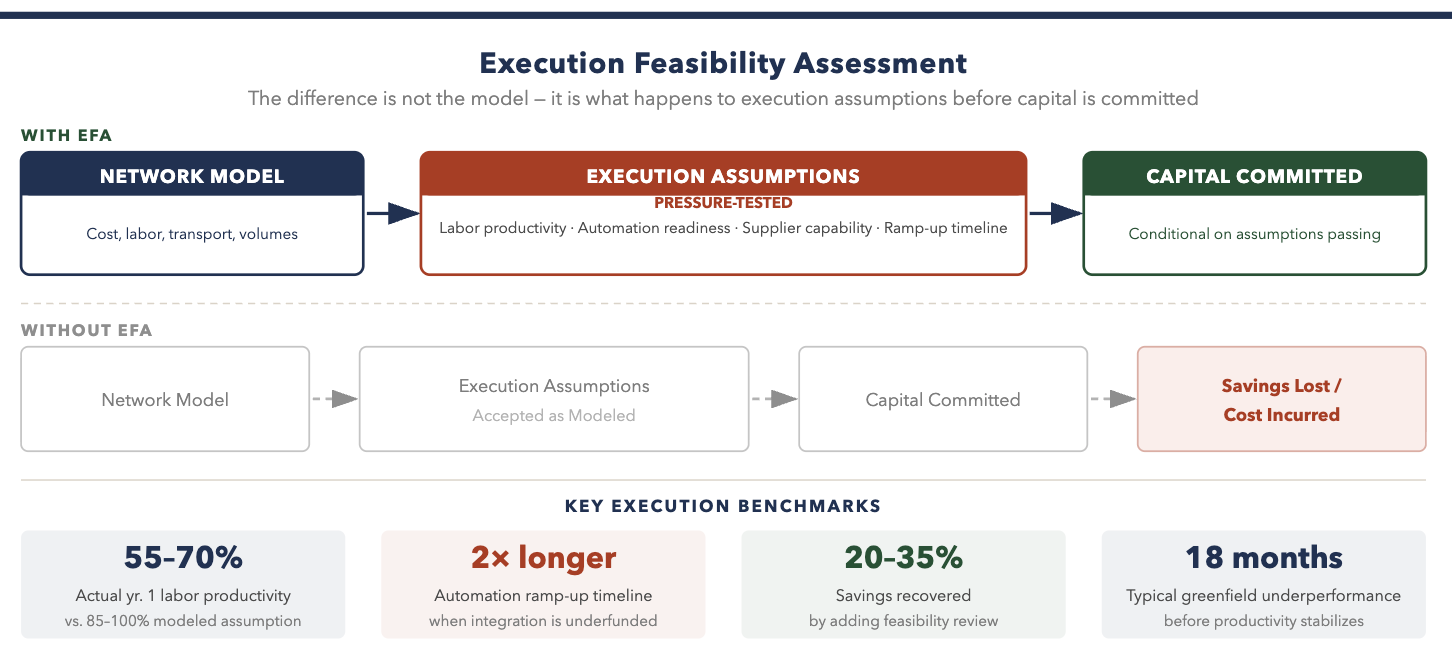
Labor productivity at a greenfield site often runs 30-40% below model assumptions for the first 18 months. Automation ramp-up often take twice as long when integration dependencies are underfunded. Supplier reliability in nearshore locations improves more slowly than procurement projects. These are not edge cases – they are the most common failure patterns in network execution. And these failure rates grow exponentially when market forces converge more acutely.
In 2026, the question is not whether a network design looks good in a model. It is whether the design can be executed — with current labor availability, automation maturity, and supplier capability.
When we model network designs, we stress test assumptions with our Execution Feasibility Assessment — a structured test of whether designs hold under real constraints before capital is committed. We embed (Gen)AI throughout the framework, including agents that rapidly ingest and analyze of structured data and documents. We test assumptions against market conditions the original model didn’t consider.
From Modeled Cost to Execution Constraints
Sophisticated network models produce accurate cost estimates using assumed conditions. The assumptions carry most of the risk, and the assumptions that break most often include:
- Labor productivity at new or ramp-up sites (typically modeled at 85-100% of target; actual first-year productivity frequently runs 55-70%)
- Automation and AI readiness: integration timelines, system dependencies, vendor delivery schedules, and the data infrastructure that AI/ML-based quality and scheduling systems need to work
- Supplier fill rates and lead times in new geographies
- Ramp-up speed for new SKUs or production processes at unfamiliar facilities
A Tier 1 automotive supplier consolidated two stamping operations into a new facility following a network review that showed $14M in annual savings. The model “mathed”, however labor productivity at the new site ran 62% of target through month 12. Automation integration slipped 7 months. The resulting service disruptions cost $8M in expediting, premium freight, and customer penalties in the first year.
Under an Execution Feasibility Assessment, each major design assumption is tested against reference data: actual ramp-up curves from comparable sites, integration timeline data from automation vendors, fill rate history from nominated suppliers. We also cross-reference assumptions against external macro signals (tariff trends, freight rates, labor availability), not just internal data. Capital is conditional on those tests passing.
We leverage AI and machine learning to run simulations across multiple scenarios in parallel, not sequentially, to compress the time requirements and improve confidence in strategy and ensuing capital commitment. We use GenAI to rapidly prototype solutions (e.g., simple process automation “bots”) accelerate insights and sharpen the business case.
Assigning Execution Ownership Before Commitment
Network designs fail in execution when operational owners are not brought in when the strategy is being set. The assumptions that break hardest are the ones supply chain, operations, and HR did not review.
The ownership structure that works:
- Network design team owns the model and total cost of ownership — and is accountable for surfacing assumption risk, not just presenting cost savings
- Operations and plant leadership own the execution feasibility review — they pressure-test productivity targets, ramp timing, integration dependencies, and AI/digital system deployment readiness before capital sign-off
- Supply chain and procurement own supplier readiness — commitments are written and verified, not modeled, before the design is finalized
- Data SMEs and engineers provide insights and access to data, including PowerPoints, PDFs, Excel, etc. documents for EFASM
The failure pattern is consistent: strategy teams design in isolation, present the business case, and hand-off to operations after approval. . Operations then spends 18 months trying to hit numbers they had little part in setting and are often unachievable.
Pressure-Testing Designs Before Capital Commitment
Most organizations have the data to stress-test network assumptions.
Feasibility signals worth tracking:
- Greenfield or ramp-up sites where labor productivity targets exceed reference data from comparable facilities in the organization’s own history
- Automation components with integration dependencies unresolved at capital approval
- Supplier commitments based on capacity projections rather than current order-to-delivery performance
- Network designs that require full automation performance within 6 months of go-live to hit cost targets
Reference data on actual ramp-up curves already exists inside most large manufacturers, and increasingly, AI tools can surface more patterns and deeper insights faster than any manual review. It is just not applied systematically at capital approval. One organization found that every network investment approved in 2023 and 2024 embedded labor productivity assumptions in the top quartile of their own historical data — with no documentation, no risk adjustment, and no one accountable for hitting them.
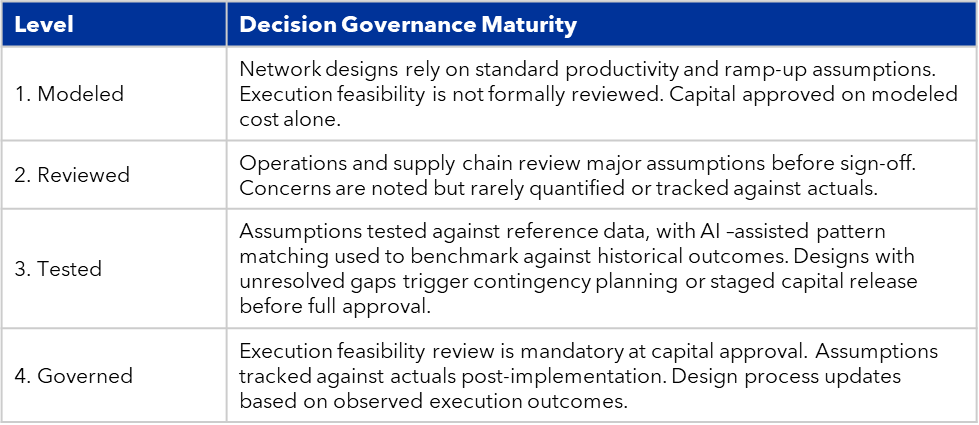
Network Execution Maturity: Where Do You Stand and What Should You Do?
Organizations progress through four stages as execution feasibility becomes embedded in strategy.
Organizations that add execution feasibility review typically recover 20-35% of projected savings that would otherwise be lost to ramp-up failure and assumption gaps in year 1.
- Before the next capital decision, run an assumption audit on the current network design. Who owns each major assumption? What is the reference data behind it? Where is the gap between model assumption and the organization’s actual historical performance at comparable sites? Leverage AI tools and agents to augment and speed up these reviews.
- For designs already in execution, identify the top three assumptions that have not been met. Do not wait for year-end. Acknowledge the gap, revise the timeline, and adjust the plan before performance deteriorates further. If you haven’t already, go back and retrofit AI-enabled review of assumptions and execution planning to optimize execution.
- Treat automation and AI as prerequisites, not enhancements. North American network designs that do not assume automation at scale in labor-constrained locations are unlikely to deliver modeled performance regardless of other design choices. AI readiness must be a key design principle to ‘future proof’ solutions.
- Model multiple scenarios before committing: the cost of running AI/ML simulations is trivial, but picking the wrong one is not.
Network strategy success is rarely a modeling problem. The organizations committing capital with confidence are the ones that have closed the gap between what the model assumes and what the operating system can actually deliver.