
Excess inventory exists not because strategy is unclear, but because trade-offs are fragmented. A planner adds buffer to protect service. A plant batches to protect efficiency. Sales pulls demand forward to protect revenue. Each decision may make sense in isolation. Holistically, they consume cash.
Inventory is not a failure of forecasting, it is the physical record of daily decisions across sales commitments, production sequencing, procurement timing, and logistics mode choices. When decisions are made independently, inventory absorbs the conflict.
Data is rarely the constraint—governance is. Safety stock targets are overridden because planners are measured on service, not cash impact. Expediting becomes routine because sales commitments create urgency without working capital accountability. Finance reviews inventory after the fact.
These patterns persist because governance rewards local optimization while diffusing accountability. If planners are measured on service, plants on OEE, and sales on revenue, working capital absorbs the tension. Shared accountability becomes no accountability.
The cost of ignoring this has increased sharply. At 5% cost of capital, every $10M in excess inventory consumes $500K annually. CFOs who once tolerated inventory as insurance now treat working capital efficiency as a strategic imperative.
Leading organizations stopped rewriting policy years ago. They are redesigning how decisions are made, owned, and escalated through what we call the Daily Trade-Off Governance Protocol.
Shifting from Metrics to Decisions
High-performing organizations move upstream. They manage the decisions that create exposure rather than managing inventory outcomes after the cash is already committed.
They identify a small set of cash-relevant decisions that occur daily or weekly. These decisions are made explicitly with clear ownership and defined timing.

Consider a building products manufacturer facing uncertain spring demand. Under fragmented governance, the plant builds ahead to protect efficiency, sales secures distributor commitments to protect Q1 revenue, and procurement locks in resin contracts to protect pricing. By March, three reasonable decisions have created $4M in slow-moving inventory.
Under Daily Trade-Off Governance, the build-ahead decision triggers cross-functional visibility before commitment rather than after the cash is consumed. The decision may still proceed, but all functions see the exposure while alternatives remain.
The principle is simple. Trade-offs must be deliberate and visible before commitment eliminates options. Centralization does not achieve this. Visibility does.
Shared Ownership is Non-Negotiable
Inventory is a shared outcome across sales, operations, and finance. Governance succeeds or fails based on role clarity under pressure:
- Sales owns demand commitments and customer trade-offs
- Operations owns flow, sequencing, and feasibility
- Finance owns cash exposure and escalation thresholds
Expedited requests require explicit acknowledgment of cash impact before approval. Batch-size increases above threshold require visibility to finance before execution. Finance defines when commitments require cross-functional review, not just how inventory is reported after month-end.
When decisions that increase inventory are visible before commitment, behavior changes quickly. “Just in case” decisions decline when cash impact is explicit.
Using Analytics to Intervene Earlier
Traditional S&OP operates on monthly cycles and explains outcomes after the fact. The Daily Trade-Off Governance Protocol operates between cycles, using execution signals to intervene before exposure becomes a write-off. This is not retrospective analysis. It is real-time decision support.
Common triggers include:
- SKUs consuming >120% of planned safety stock for 3+ consecutive weeks
- Batch sizes growing 15%+ over two quarters
- Customers or lanes driving >25% of expedite spend
- Plans executing <80% on-time for 4+ weeks
Dashboards explain what happened. Triggers create the moment to act. The discussion shifts from “what happened” to “do we accept this exposure.”
Most organizations already have the data. What they lack is the governance layer that converts visibility into intervention. Advanced analytics and AI can surface risk earlier, but visibility without decision authority remains information, not action.
Governance Maturity: Where Do You Stand?
Organizations progress through four stages in decision governance.
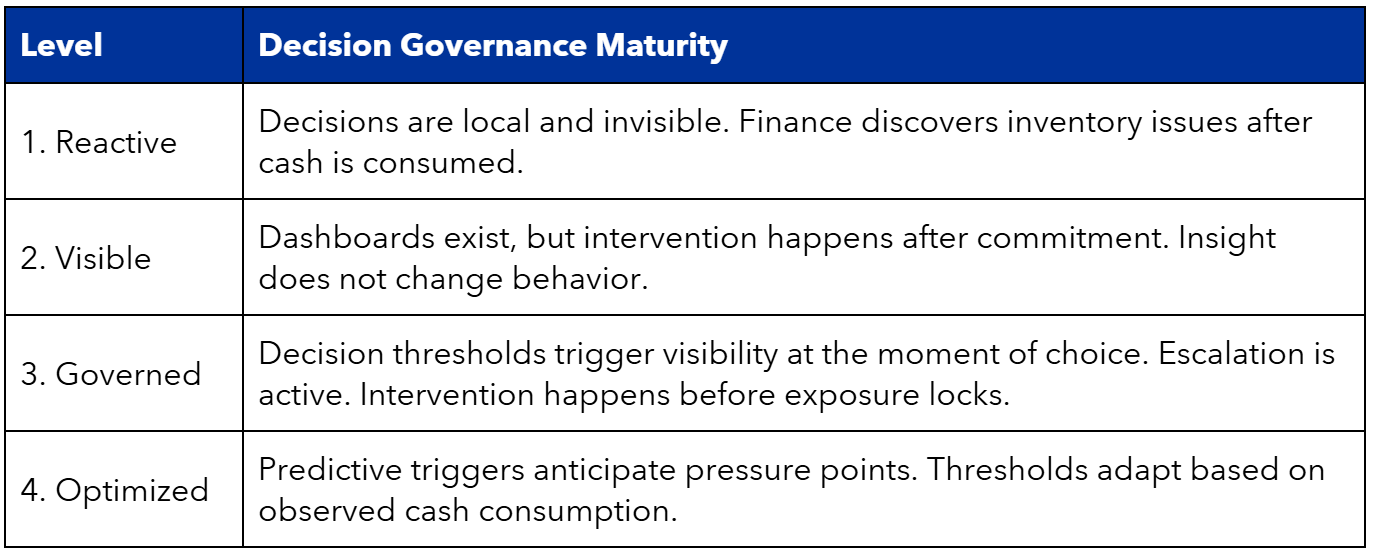
If your organization cannot name who made the last decision that consumed significant working capital, you are at Level 1.
What Operators Should Do Now
Organizations typically achieve 15-25% inventory improvement as governance matures. In 2026, improving working capital requires operating discipline, not new targets.
- Start with a two-week decision audit across sales, operations, and procurement. Identify the five to ten decisions that most affect working capital and quantify their cash impact. Secure executive sponsorship. Governance without it fails by week six
- Assign ownership. Define thresholds. Intervene before commitment. Document outcomes.
- Start manually. Automate only after patterns stabilize.
The organizations releasing cash in 2026 made decision governance a core operating capability. Better dashboards do not deliver results. Making trade-offs visible before they become write-offs does.
If you do one thing, implement the 2-week decision audit. Most organizations cannot name who made the decision behind their last $5M inventory write-off. Governance begins when someone can answer that question.