
When “AI @ Scale” fails, it is rarely because the technology was wrong. Failure results when the operating model is not redesigned to absorb it.
Organizations must consider the question of who makes the decision when algorithmic recommendations conflict with a planner’s judgment. Pilots, in controlled environments with strong sponsors, typically produce great results. Scaling-up these pilots expose underlying problems: ownership and accountability must be redesigned, roles must be updated, and incentives must reward the behaviors the automation was intended to replace.
Leading organizations are closing this gap through Operating Model Alignment — an explicit redesign of decision ownership, roles, and governance before automation and AI are deployed at scale.
Organizing Around Decisions, Not Functions
The most common operating model challenge is deploying AI tools within functional roles when the value comes from coordinating decisions across them.
A demand sensing tool creates value when the signal it produces triggers a supply commitment. That requires coordination across commercial, planning, and operations. If those functions operate in silos with separate KPIs, the acknowledgement and action on the signal will be inconsistent.
The decisions AI most commonly support:
- Which demand signals to accept versus flag for human review (the demand confirmation decision)
- Which production sequence to run based on current constraint signals (the scheduling decision)
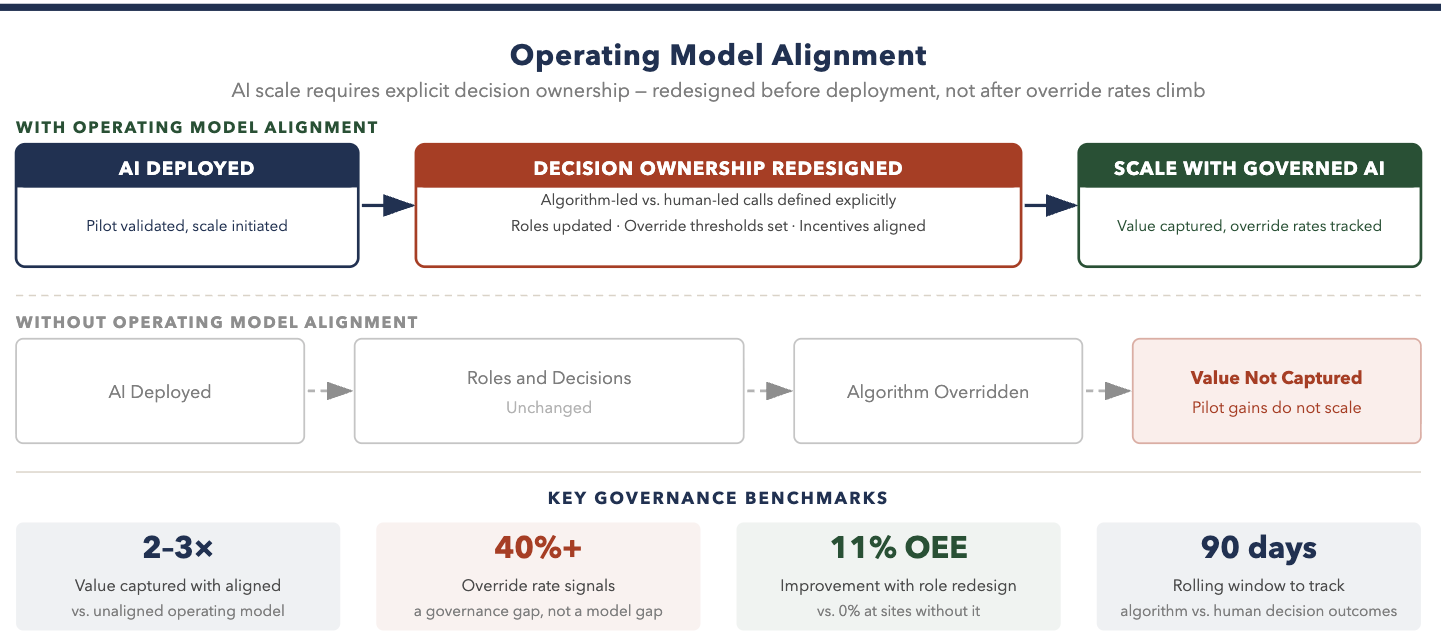
A medical device manufacturer deployed a predictive scheduling tool across three sites. At Site A, planners were retrained and explicitly told which scheduling decisions were now algorithm-led and human-reviewed. Changes to algorithm-led decisions we’re still allowed but had to be backed up by data and approved by the team. OEE improved 11% in four months. At Sites B and C, the tool was installed without role redesign. Planners overrode the algorithm 60% of the time, mostly to protect their existing service metrics. The tool produced no measurable improvement at either site.
Making Decision Ownership Explicit
AI-supported decisions require a different governance model than those deployed with human-only decisions. The conflict between algorithmic output and human judgment must be resolved in the design — not in the moment when a planner is staring at a recommendation that contradicts their instinct.
Governance should consider:
- Algorithm owners define decision types, confidence thresholds, and escalation triggers — and are accountable for accuracy and output quality
- Decision owners are explicitly told which calls are algorithm-led (human override only for defined exceptions) versus human-led (algorithm input only)
- Operational leadership sets and reviews override rates — a rising override rate is an operating model problem, not a technology problem
Incentives must align with the new model to reinforce desired behaviors. For example, if planners are measured on service alone and the algorithm recommends accepting a service risk to protect cash, will the planner override the suggestion?
Using Outcomes to Calibrate and Improve
What organizations track and the resolution of overside rates matter. Signals worth tracking include:
- Override rate by decision type and decision owner — rising overrides signal governance gaps or model drift
- Decision cycle time — from signal to committed action, tracked against the pre-automation baseline
- Outcome accuracy — algorithm-led decisions compared to human-led decisions on the same decision type, over 90-day rolling windows
- Escalation frequency — decision types flagged for human review more than 20% of the time indicate threshold miscalibration
Where Do You Stand and What Should You Do?
Organizations progress through four stages as operating model alignment tightens.
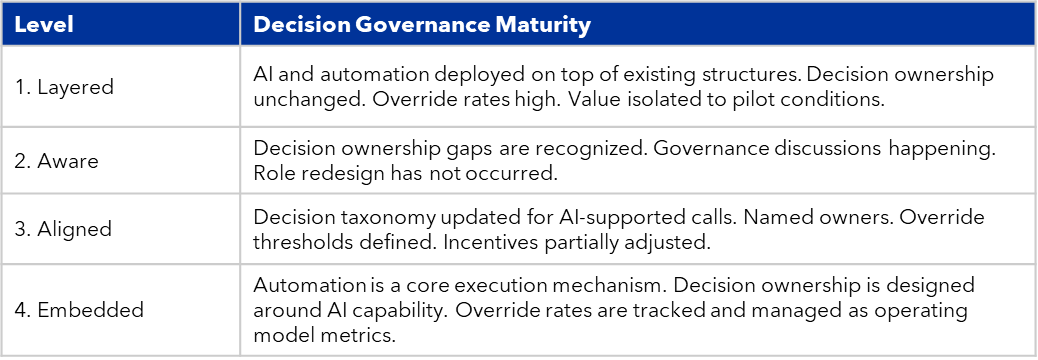
Organizations that redesign decision ownership before scaling AI consistently capture 2-3x the value of organizations that layer AI onto existing structures.
- Run an override audit on your current AI deployments. What percentage of algorithm recommendations are being overridden? By whom? For what reasons? A 40%+ override rate is a governance problem, not a model problem.
- Map the top five AI-supported decisions and assign explicit ownership. Define which decisions should be algorithm-led and which are human-led with algorithmic input. Write it down. Communicate it. Then train to it.
- Adjust incentives to align with the new model before deploying the next tool. If the operating model rewards the behavior the algorithm is designed to change, the algorithm will not change behavior.
If you do one thing, pull the override rate on your largest AI deployment. If you cannot calculate that number, that is the first gap to close. Remember, AI will not fix a broken operating model. But a well-designed operating model will make even imperfect AI valuable. The difference will be visible in decision velocity, not model accuracy.